


September 12, 2026
AUTHORHassan Sukhera
Lead Consultant
Primary sources, stated limitations and practical next steps.
Discuss this with Forged-CS General information only. Security and privacy obligations vary by jurisdiction and circumstance. Obtain legal or specialist advice where required.Enterprise cybersecurity programs routinely allocate tens of millions of dollars to fortify internal firewalls, deploy endpoint detection agents, and enforce zero-trust access controls across corporate infrastructure. Yet sophisticated threat actors rarely expend effort attempting to breach hardened corporate perimeters when an executive’s personal life offers an unmonitored, vulnerable path directly to critical assets. Corporate leaders, board members, and high-net-worth individuals (HNWIs) increasingly conduct high-stakes communications across private mobile devices, residential Wi-Fi networks, and personal cloud accounts that operate entirely outside corporate visibility. Digital executive protection addresses this systemic exposure by systematically analyzing, monitoring, and mitigating the personal cyber, dark web, and open-source intelligence (OSINT) risks surrounding key personnel. Rather than treating personal digital privacy and physical security as isolated disciplines, modern risk governance requires an intelligence-led architecture where physical close protection details and digital threat intelligence operate as a synchronized, proactive defense.
Key Takeaways: The Realities of Digital Executive Protection
- The Corporate Perimeter Has Dissolved: Over 51% of cybersecurity professionals confirm that the personal digital lives of their executive leadership have been directly targeted by adversaries, according to the Ponemon Institute 2025 Digital Executive Protection Report. Attackers exploit unmanaged residential infrastructure and personal digital exhaust rather than enterprise security controls.
- Physical Safety Is Bound to Digital Exposure: Digital breaches are no longer purely technical incidents. Half of corporate security directors surveyed by the Ponemon Institute anticipate physical attacks against executives enabled by home addresses, travel patterns, and personal schedules leaked online through data brokers, public records, and dark web dumps.
- AI Impersonation and Deepfakes Accelerate Fraud: Advanced generative audio and video synthesis have lowered the barrier for high-velocity executive impersonation. More than 41% of organizations have documented deepfake campaigns mimicking their leadership to execute business email compromise (BEC) and unauthorized capital transfers.
- Siloed Defenses Create Critical Blind Spots: Approximately 63% of enterprise security teams lack visibility into executive home networks, while 48% of corporate security programs allocate zero formal budget to digital executive protection. Effective risk mitigation requires uniting corporate IT security, dark web threat monitoring, and on-the-ground physical protection teams into a unified command structure.
- Proactive Surface Reduction Outperforms Reactive Incident Response: Scrubbing executive Personally Identifiable Information (PII) from commercial data brokers, enforcing hardware security keys on personal accounts, and establishing real-time dark web tripwires significantly decreases targeting feasibility before hostile reconnaissance converts into active harassment or physical confrontation.
The Perimeter Collapse: Why Personal Cyber Risk Threatens Enterprise Security
Corporate security models have historically relied on a fortress doctrine: isolate corporate servers behind redundant firewalls, issue managed enterprise laptops, enforce endpoint detection and response (EDR), and restrict corporate network access via authenticated VPN tunnels. This model assumes that the critical assets and the people who control them exist within an enterprise perimeter.
In practice, that perimeter dissolved years ago. C-suite executives, board members, and high-net-worth family principals operate fluidly between boardrooms, private residences, private aviation terminals, international hotels, and personal retreats. They review sensitive strategic initiatives, evaluate acquisition targets, and authorize financial transactions from personal smartphones and unmanaged home workstations.
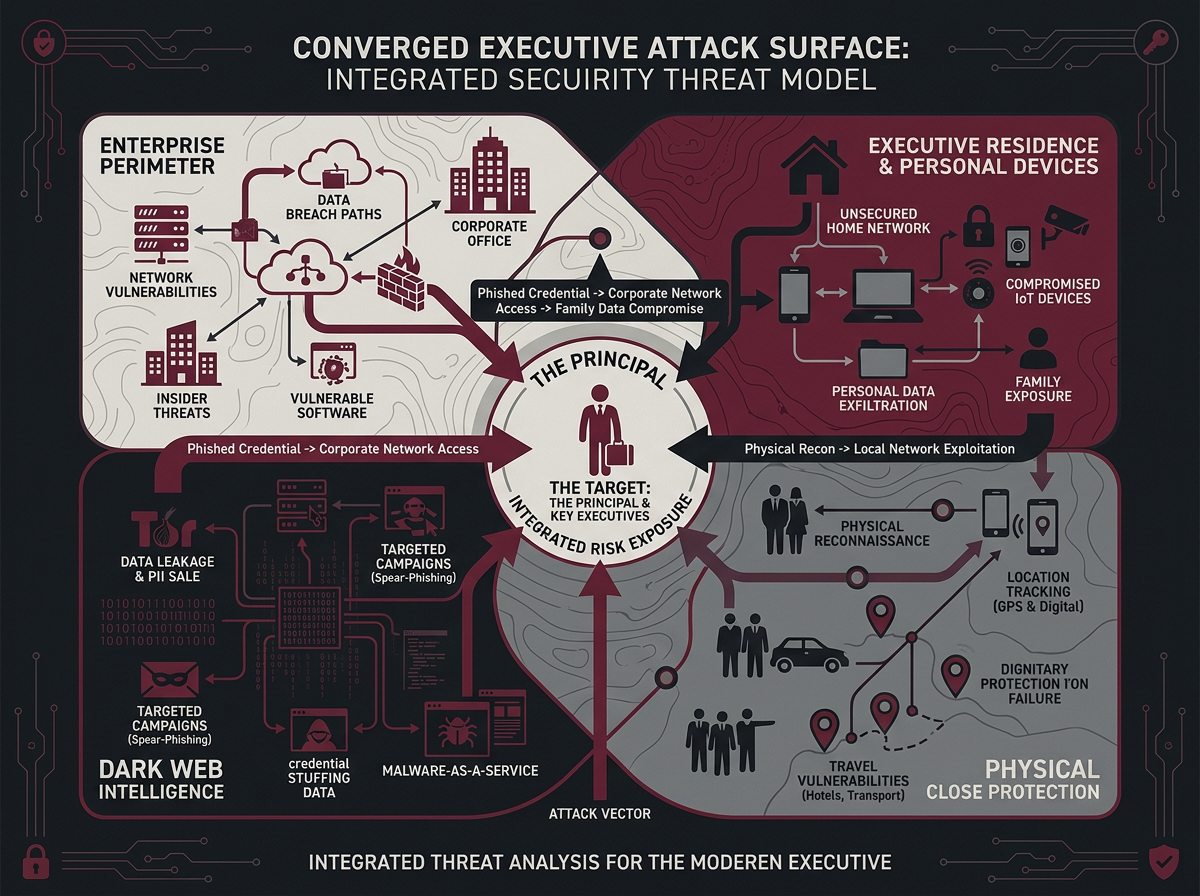
Adversaries understand this operational reality. Cybercrime syndicates, state-sponsored intelligence operatives, and extortionists do not attack the $50 million corporate security infrastructure when they can exploit an executive’s unpatched home router or compromise a family member’s social media account. As highlighted in Gartner’s research on executive protection solutions, cyber-enabled threats increasingly intersect with the physical world, creating vulnerabilities that traditional enterprise security controls cannot see or remediate.
The Anatomy of Personal Attack Surfaces
The personal attack surface of an executive differs fundamentally from corporate IT infrastructure. It consists of disparate, unmanaged, and consumer-grade touchpoints:
- Residential and Remote Networks: Home Wi-Fi environments routinely host dozens of consumer Internet of Things (IoT) devices—smart thermostats, security cameras, unpatched streaming devices, and voice assistants—on flat, unsegmented networks. When an executive connects a personal tablet holding confidential board documents to the same subnet as an insecure smart device, a compromised IoT gadget provides an direct lateral pivot to executive communications.
- Digital Exhaust and Public Record Aggregation: Hundreds of commercial data brokers aggregate personal details from voter registrations, property deeds, DMV filings, and marketing databases. Within minutes, anyone can acquire an executive's home address, unlisted personal mobile number, names and ages of family members, vehicle registrations, and prior residential histories.
- Family Ecosystem Vulnerabilities: Hostile actors frequently bypass the primary target altogether, directing social engineering campaigns toward spouses, teenage children, or household staff (private chefs, estate managers, personal assistants). Spouses and dependents frequently utilize public social media profiles that reveal live vacation locations, daily routines, and school attendance, generating actionable open-source intelligence (OSINT) for adversaries.
- Personal Account Compromise and SIM Swapping: Attackers execute SIM-swapping attacks by bribing telecom staff or exploiting social engineering vulnerabilities to hijack an executive’s phone number. Once the phone number is intercepted, short-message-service (SMS) two-factor authentication (2FA) collapses, unlocking personal email accounts, password managers, and banking applications.
Research conducted by the Ponemon Institute reveals that 63% of enterprise Chief Information Security Officers (CISOs) acknowledge having zero operational visibility into their executives' home networks, while 60% admit their security operations have no means to enforce basic password hygiene on leadership's personal devices. When these personal domains are compromised, adversaries harvest credentials, stage targeted spear phishing, and gather intelligence that jeopardizes corporate operations and physical safety. Organizations that treat executive security as an office-hours problem leave their most critical decision-makers exposed precisely where they spend the majority of their lives. Specialized advisory firms like Forged-CS provide integrated threat intelligence to close these unmonitored gaps before threat actors exploit them.
Core Pillars of a Digital Executive Protection Program
A comprehensive digital executive protection (DEP) program moves beyond ad-hoc privacy settings. It deploys an active, layered security posture engineered to anticipate adversary reconnaissance, neutralize personal attack surfaces, and continuously monitor illicit channels. Four core operational pillars form the foundation of an effective program.
1. OSINT Footprint Auditing and Continuous Data Broker Removal
Adversaries begin their campaigns with extensive reconnaissance, relying heavily on open-source intelligence (OSINT). Attackers systematically scour social media archives, family member accounts, public property deeds, political donation filings, corporate SEC disclosures, and data aggregators to build exhaustive target dossiers.
A disciplined digital executive protection methodology systematically audits and dismantles this visibility:
- Surface Exposure Mapping: Security analysts conduct deep-dive OSINT investigations simulating the techniques of sophisticated adversaries. This maps personal email addresses, private phone numbers, physical residences, secondary vacation properties, luxury asset registries (aircraft and yachts), and social circles.
- Continuous Data Broker Elimination: Commercial data aggregators continuously scrape and republish personal information. One-time opt-out requests are insufficient, as brokers refresh their databases with new public records within 60 to 90 days. A professional program runs automated, continuous opt-out enforcement across hundreds of data broker platforms to scrub executive addresses, family connections, and financial breadcrumbs.
- Legal and Entity Obfuscation Advisory: High-profile principals must decouple their legal identities from physical properties. Operating through blind trusts, qualified LLCs, and private registration services ensures that public land registries, vehicle registrations, and municipal utility connections do not tie an executive's name to a physical residence.
2. Dark Web and Illicit Forum Intelligence
Data breaches occurring at retail merchants, healthcare systems, hotels, and airline loyalty platforms routinely expose personal credentials and sensitive behavioral data. Once breached, these records migrate to illicit dark web marketplaces, criminal paste sites, and closed messaging channels.
According to research in the Gartner Magic Quadrant for Cyberthreat Intelligence Technologies, modern threat intelligence must integrate specialized adversary tracking across illicit ecosystems. In an executive protection context, this entails:
- Stealer Log and Credential Monitoring: Information-stealing malware (such as Lumma, RedLine, and Vidar) compromises consumer devices worldwide, exfiltrating autofill credentials, browser cookies, and session tokens. Analysts monitor underground logs in real time to identify exposed personal passwords, financial logins, and corporate access credentials before threat actors weaponize them.
- Hostile Forum and Doxxing Channel Surveillance: Threat actors frequently coordinate targeted campaigns, share hacked personal dossiers, or solicit physical harassment across darknet discussion boards and encrypted Telegram channels. Continuous human- and machine-driven intelligence monitoring detects discussions referencing executive names, family members, or physical locations immediately.
- Tripwires and Early Warning Triggers: Setting up automated digital tripwires across illicit channels provides early alerts when an executive's domain, corporate email handle, or personal identifiers surface in adversary chatter, enabling swift preventative countermeasures.
3. Personal Infrastructure and Communications Hardening
Protecting corporate networks while ignoring home infrastructure leaves the front door unlocked. Digital executive protection brings enterprise-grade network architecture and device hygiene into private residences and personal mobile hardware without disrupting the principal's lifestyle.
- Segmented Residential Network Architecture: Private estates and executive residences require professional network segmentation. By isolating consumer IoT devices (smart TVs, automated lighting, voice assistants) onto dedicated virtual local area networks (VLANs), an attack compromising a smart appliance cannot traverse to the secure subnet hosting executive laptops and tablets.
- Hardware-Enforced Multi-Factor Authentication: Standard SMS-based two-factor authentication is critically vulnerable to telecom interception and SIM-swapping attacks. Digital executive protection mandates the deployment of FIDO2-compliant physical hardware security keys (such as YubiKeys) across all primary personal accounts—including personal email, Apple IDs, Google accounts, and password vaults.
- Encrypted Communications Channels: High-stakes strategic discussions, private family coordination, and sensitive travel schedules must not occur over standard, unencrypted SMS or consumer messaging apps. Implementing audited end-to-end encrypted platforms (such as Signal or Proton) with ephemeral messaging ensures that intercepted data cannot be decrypted or stored on third-party servers.
4. Social Engineering, Spear Phishing, and Deepfake Countermeasures
As generative AI technology accelerates, attackers execute hyper-personalized social engineering campaigns. The Ponemon Institute 2025 Deepfake Deception Report revealed that 41% of organizations have already faced direct deepfake incidents targeting corporate leadership.
Combatting these threats requires both procedural governance and technical safeguards:
- Synthetic Voice and Video Verification Protocols: Threat actors can clone an executive's voice using as little as three seconds of public audio harvested from earnings calls, media interviews, or podcast appearances. Organizations and family offices must implement strict out-of-band verification procedures. Any urgent, atypical request for capital deployment, wire transfers, or sensitive credential resets must require secondary confirmation via a pre-established verbal authentication code known only to trusted personnel.
- Whaling Defense and Context-Aware Threat Modeling: Targeted spear phishing directed at leadership (whaling) relies on meticulous personal context extracted from family activities, alumni associations, and charitable boards. Threat intelligence teams conduct realistic attack simulations and deliver bespoke briefing sessions tailored to the executive's actual digital footprint.
By deploying these four pillars in concert, organizations establish an active barrier around leadership. Integrating this digital intelligence with the physical protection services provided by Forged-CS ensures that digital signals immediately translate into tactical on-the-ground awareness.
Unifying Physical Protection with Cyber and Dark Web Intelligence
Historically, corporate security departments have maintained a rigid operational divide: cyber threat intelligence teams operated within the information technology organization, while executive protection details reported into corporate facilities, human resources, or legal counsel. This operational siloing creates severe vulnerabilities. When cyber analysts detect an executive's home address circulating on an extremist forum, but physical security details are never informed, the protective detail remains blind to potential hostile surveillance.
Conversely, when physical security operatives note suspicious reconnaissance near a principal’s residence but lack cyber intelligence support, they cannot identify the digital breadcrumbs or online coordination driving the behavior. Modern risk mitigation requires the systematic convergence of physical close protection and real-time digital intelligence.

How Digital Intelligence Powers Advance Physical Operations
As detailed in our analysis of what a close protection officer actually does on the ground, up to 90% of security incidents are prevented during the advance planning phase. Close protection operatives (CPOs) do not rely on reactive force; they rely on meticulous intelligence to avoid confrontations entirely. Digital threat intelligence provides the primary operational foundation for this advance work.
Prior to an executive traveling to an overseas summit, attending a high-profile public forum, or visiting a contested facility, digital threat analysts execute synchronized reconnaissance:
- Geolocated OSINT and Social Chatter Monitoring: Analysts establish virtual geofences around intended travel routes, scheduled hotels, conference venues, and alternate safe havens. Monitoring live social media sentiment, local activist coordination channels, and regional dark web forums reveals impending civil unrest, targeted protests, or hostile surveillance before the principal departs.
- Flight and Travel Obfuscation: Commercial flight trackers and public Automatic Dependent Surveillance–Broadcast (ADS-B) feeds allow amateur enthusiasts and threat actors to track private aviation tail numbers in real time. Intelligence teams coordinate with aviation providers to enroll aircraft in privacy blocking programs (such as the FAA's LADD and PIA programs) and establish deceptive movement protocols when necessary.
- Venue Cyber Reconnaissance: Intelligence teams evaluate the digital posture of destination facilities. Open hotel Wi-Fi networks, conference Bluetooth environments, and unvetted audiovisual equipment represent fertile ground for opportunistic digital interception and corporate espionage. The protective detail is equipped with pre-configured mobile hotspots, physical data-blockers (USB condoms), and Faraday isolation bags to shield executive devices while in transit.
The Threat Escalation Matrix: From Digital Signal to Physical Response
Adversaries rarely transition immediately from zero awareness to a kinetic physical assault. Violent attacks, targeted extortions, and kidnappings are preceded by a predictable pathway of targeted violence: ideation, grievance formation, digital reconnaissance, information sharing, and physical probing.
An integrated digital and physical protection program establishes concrete operational tripwires that automatically escalate protective postures based on digital indicators:
| Threat Level | Digital Intelligence Indicators | Operational Coordination | Physical Security Posture |
|---|---|---|---|
| Level 1: Passive Baseline | Routine web presence; minor mentions on business forums; no targeted hostility or credential dumps. | Continuous automated OSINT audits and monthly data broker scrubbing. | Standard residential security posture; normal mobile situational awareness. |
| Level 2: Elevated Exposure | Personal credentials identified in dark web stealer logs; PII posted to public aggregator sites; generic hostile rhetoric. | Cyber team resets credentials, revokes active sessions, and enforces hardware MFA. Physical team notified of target profile. | Heightened residential surveillance; verification of residential perimeter sensors and access logs. |
| Level 3: Targeted Reconnaissance | Specific doxxing of private residence, personal mobile numbers, or family routines on illicit forums or Telegram channels. | Joint intelligence briefing between cyber analysts and protective detail leads. Law enforcement liaison initiated. | Deployment of dedicated Close Protection Officers (CPOs); advance route surveys conducted; dynamic route alternation enforced. |
| Level 4: Imminent Staging | Active solicitation of physical harm, direct death threats with corroborated location data, or detected hostile surveillance. | Real-time tactical intelligence feeds streamed to protective details; rapid crisis coordination with emergency services. | 24/7 close protective escort; secure vehicle transport; immediate relocation to secure secondary residence if necessary. |
By aligning digital warning signs with specific physical countermeasures, security directors eliminate ambiguity. Close protection details no longer operate on intuition alone; they operate with decision-grade intelligence provided by integrated firms like Forged-CS.
Governance and Risk Prioritization: Tailoring Protection Across Key Stakeholders
Digital executive protection is not a generic, off-the-shelf security package. The threat profile of a Fortune 500 Chief Executive Officer navigating regulatory scrutiny differs substantially from a multi-generational family office managing liquid capital or an independent corporate board director serving across multiple public entities. Effective risk governance demands tailored protection models calibrated to each stakeholder group's specific exposure vectors and legal responsibilities.
Stakeholder Exposure Matrix
| Stakeholder Category | Primary Threat Vectors | Governance & Fiduciary Drivers | Primary Protective Focus | Resource Allocation Model |
|---|---|---|---|---|
| C-Suite Executives (CEO, CFO, CISO) | Spear phishing (whaling), corporate credential theft, executive extortion, deepfake voice authorization fraud. | Corporate Duty of Care, SEC cybersecurity disclosure regulations (Item 106), shareholder value preservation. | Hardening personal devices, residential network segmentation, continuous dark web monitoring, real-time executive travel intelligence. | Corporate security budget; integrated enterprise risk management (ERM). |
| Corporate Board Directors | Personal email account compromise, multi-board lateral infection, confidential M&A leaks, interception of non-public board materials. | Fiduciary liability, non-disclosure compliance, regulatory penalties for insider data exposure. | Strict isolation of board communications, hardware MFA keys, personal tablet hardening, data broker PII eradication. | Shared corporate risk allocation; standardized board security onboarding packages. |
| Family Offices & Principal Estates | Capital diversion via BEC, synthetic voice wire fraud, estate staff social engineering, extortion, child kidnapping reconnaissance. | Wealth preservation, multi-generational privacy protection, trustee fiduciary duty. | Household network architecture, vetting of domestic staff, continuous OSINT exposure mapping, emergency duress protocols. | Family office operational overhead; private client advisory retainer. |
| High-Net-Worth Individuals & Founders | Targeted doxxing, digital physical stalking, public reputation sabotage, account takeover, crypto asset theft. | Personal and familial safety, brand protection, uninhibited lifestyle mobility. | Deep personal PII removal, continuous adversary forum surveillance, integrated physical close protection coordination. | Personal security budget; hybrid private security and intelligence engagement. |
C-Suite Leadership: Fiduciary Duty and Enterprise Contagion
For enterprise leadership, executive cyber protection is no longer an optional executive perk—it is an enterprise risk management requirement. When a CEO's personal email or residential Wi-Fi router is breached, the attacker does not just compromise personal holiday photos; they obtain non-public strategic memos, unannounced acquisition targets, and executive calendars.
Under updated regulatory frameworks, including the U.S. Securities and Exchange Commission (SEC) rules on cybersecurity disclosures, organizations must demonstrate robust risk management processes for material cyber risks. If an adversary penetrates an enterprise network via an executive's compromised personal device, boards face severe regulatory and shareholder scrutiny regarding whether reasonable preventative controls were maintained. Forward-thinking enterprises formally budget digital executive protection within their corporate information security and executive compensation frameworks, ensuring comprehensive protection that extends beyond the corporate network.
Corporate Boards: The Multi-Company Contagion Vector
Corporate board directors represent one of the most glaring vulnerabilities in modern corporate governance. Board members are frequently granted access to the most confidential corporate data—including earnings releases, proprietary IP, board committee presentations, and crisis management plans. However, board members rarely receive managed corporate hardware or dedicated enterprise IT support.
Instead, directors frequently download sensitive corporate materials onto personal iPads, communicate via personal commercial email addresses (such as Gmail or iCloud), and travel internationally with unhardened personal devices. Because directors often sit on multiple corporate boards, a single compromised director email account can serve as a launchpad for spear phishing across several distinct multinational corporations. A disciplined digital executive protection framework establishes standardized security configurations for board members, implementing hardware-enforced authentication, device encryption, and secure file viewing protocols without requiring invasive corporate software on personal equipment.
Family Offices and HNWIs: Protecting Wealth and Family Safety
Family offices face an asymmetric threat profile: they manage sovereign-scale capital often exceeding billions of dollars in assets under management (AUM), yet operate with lean administrative teams that lack the defensive depth of enterprise security operations centers. The Family Office Security & Risk Report 2025 established that 57% of North American family offices experienced a cyberattack within the prior two years, with 93% facing targeted spear phishing or business email compromise (BEC).
In a family office environment, digital risk translates directly into physical and financial peril:
- Capital Transfer Fraud: Adversaries monitor family office email communications to map transaction workflows, capital call schedules, and banking relationships. Utilizing AI voice cloning, attackers mimic the family principal to request urgent wire transfers to fraudulent accounts.
- Domestic Staff as Attack Vectors: Threat actors target household staff—estate managers, private pilots, personal assistants, and nannies—who possess intimate knowledge of family travel schedules, residential entry codes, and principal whereabouts. A digital protection program must extend security hygiene and continuous monitoring to the entire domestic ecosystem.
- Physical Safety of Dependents: Young family members frequently utilize social media platforms without understanding digital privacy risks. Tagged locations, school sports schedules, and unvetted connections provide adversaries with the exact logistical data required to execute targeted harassment, stalking, or ransom plots.
Securing family offices requires a discreet, highly customized touch. Advisory firms like Forged-CS engineer bespoke privacy and protective architectures that safeguard family autonomy and privacy while establishing institutional-grade resilience.
Operational Playbook: Deploying a Proactive Digital Executive Protection Program
Implementing digital executive protection cannot be treated as an overnight software installation. Because it touches the private lives, personal homes, and families of prominent individuals, the program must balance uncompromising security controls with personal privacy, discretion, and operational ease. A program that introduces excessive friction will be bypassed by the principal.
A battle-tested deployment methodology follows four structured phases designed to establish immediate risk reduction while building long-term defensive resilience:
- Phase 1: Baseline Audit & Footprint Discovery — Quantifying external exposure through OSINT assessments, dark web credential analysis, and residential network vulnerability scans.
- Phase 2: Technical Hardening & Attack Surface Reduction — Purging data broker listings, segmenting home network architecture, deploying hardware MFA keys, and establishing encrypted communications.
- Phase 3: Continuous Threat Intelligence & Active Monitoring — Maintaining real-time dark web tripwires, continuous PII scrubbing, and pre-travel geofenced threat intelligence.
- Phase 4: Converged Incident Escalation & Physical Coordination — Synchronizing cyber alerts with protective details, conducting joint tabletop simulations, and maintaining out-of-band crisis protocols.
Phase 1: Baseline Audit and Attack Surface Discovery
Before implementing security countermeasures, organizations must understand precisely what an adversary can discover. The program initiates with an exhaustive threat assessment:
- Executive Digital Footprint Audit: Analysts execute an adversarial OSINT assessment, cataloging every piece of publicly accessible data related to the executive, their spouse, children, and personal properties. This identifies exposed personal phone numbers, primary email addresses, previous residential locations, vehicle data, and family relationships.
- Dark Web Exposure Analysis: Security teams query historical and real-time dark web databases, paste sites, and threat actor repositories to identify compromised passwords, active session cookies, and past data breach disclosures associated with personal accounts.
- Residential Network and Device Audit: A non-invasive audit of the principal's home network evaluates router firmware versions, Wi-Fi encryption protocols, open network ports, and connected IoT devices. Personal devices (smartphones, laptops, tablets) are audited for operating system updates, unvetted applications, and security posture.
Phase 2: Technical Hardening and Attack Surface Reduction
With the threat landscape quantified, teams execute targeted remediation to eliminate exposed attack vectors:
- Data Broker Scrubbing: Security operations initiate automated, legally binding removal requests across commercial data aggregators and people-search engines. This immediately removes executive home addresses, phone numbers, and family connections from public directories.
- Residential Network Architecture Overhaul: Qualified network specialists reconfigure residential networks. High-risk IoT devices (smart TVs, automated blinds, connected HVAC units) are isolated on a dedicated, firewalled guest subnet. Critical executive workstations, personal laptops, and encrypted storage units are assigned to a secured, encrypted network tier equipped with enterprise-grade intrusion prevention and encrypted DNS filtering.
- Credential and Authentication Overhaul: All critical personal accounts (primary email, Apple ID, password managers, financial portals) are transitioned from SMS-based two-factor authentication to physical FIDO2 hardware security keys (such as YubiKeys). Passwords are transitioned to cryptographically generated strings managed through an enterprise-grade password vault.
- Secure Communication Implementation: Principals and their immediate inner circle (family, executive assistants, key advisors) are onboarded to end-to-end encrypted messaging platforms. Ephemeral messaging parameters are established for travel logistics and sensitive operational decisions.
Phase 3: Continuous Intelligence and Threat Monitoring
Hardening provides a baseline defense, but threat landscapes evolve constantly. Continuous operational monitoring ensures that emerging risks are identified before they convert into attacks:
- Dark Web and Stealer Log Monitoring: Real-time automated sensors scan underground marketplaces, malware-stealer logs, and criminal chat networks for newly leaked credentials or discussions naming the principal, family members, or physical residences.
- Continuous Surface Hygiene: Automated scans monitor data broker registries continuously, instantly executing takedown notices whenever public records databases refresh their indexes.
- Pre-Travel Intelligence Briefings: Before international or high-profile domestic movements, threat analysts generate geolocated threat assessments covering local political stability, cyber interception risks at transit points, and regional criminal activity.
Phase 4: Converged Incident Escalation and Physical Coordination
The final phase establishes operational bridges between cybersecurity analysts and physical protection operatives:
- Unified Threat Escalation Procedures: As established in our operational matrices, security teams formalize specific protocols defining when a cyber threat (such as doxxing or targeted harassment) automatically triggers an increased physical protection posture.
- Out-of-Band Crisis Communication: In the event of an account compromise, synthetic media extortion, or physical security emergency, protective details and executive leadership utilize dedicated, unhackable communication channels that bypass corporate and consumer telecom networks.
- Regular Tabletop Simulation: Corporate leadership, board members, family office trustees, and security teams conduct periodic crisis simulation drills. Scenarios include AI voice cloning wire transfer attempts, executive doxxing incidents, and synchronized physical-digital stalking, testing response times and decision-making under realistic pressure.
Executing this operational playbook requires cross-disciplinary expertise combining deep cyber forensics with tactical protection capabilities. Engaging an integrated firm such as Forged-CS allows organizations to implement this entire lifecycle through a single, coordinated partner.
Frequently Asked Questions About Digital Executive Protection
What distinguishes digital executive protection from standard corporate cybersecurity?
Standard corporate cybersecurity focuses on securing corporate infrastructure—enterprise networks, corporate-owned endpoints, cloud repositories, and identity access management systems within the enterprise domain. Digital executive protection addresses the unmanaged personal perimeter of the executive: personal smartphones, residential Wi-Fi networks, smart home IoT devices, personal email accounts, and commercial data broker disclosures. While corporate IT controls end where corporate policy stops, digital executive protection secures the leader across their private and mobile life, neutralizing the indirect pathways adversaries use to reach corporate systems.
How does an executive's personal digital exposure directly threaten physical safety?
When threat actors conduct digital reconnaissance, they gather actionable physical data: residential property deeds, real-time geolocation tags from social media posts, vehicle registrations, and children's daily school schedules. If an executive or their organization faces severe public controversy or adversary targeting, this digital exhaust enables stalkers, disgruntled individuals, or criminal syndicates to execute physical surveillance, residential harassment, or targeted confrontation. Removing Personally Identifiable Information (PII) from commercial databases and dark web forums directly denies hostile actors the geographical intelligence required to mount physical operations.
How can family offices and HNWIs implement protection without compromising personal privacy?
High-net-worth families often resist security measures because they fear intrusive corporate oversight into their private communications and domestic affairs. A professionally managed digital executive protection program respects personal boundaries by focusing on architecture and intelligence rather than invasive surveillance. Security teams harden residential routers, segment guest networks, and eliminate public data broker records without installing invasive monitoring software on personal devices or reading private correspondence. Protection is delivered through defensive infrastructure, continuous threat monitoring, and proactive privacy advisory rather than restrictive surveillance.
What role does dark web intelligence play in executive security?
Dark web intelligence acts as an early warning tripwire. Long before an adversary attempts an account takeover, extortion campaign, or physical approach, stolen credentials and planning discussions circulate on illicit underground forums, paste sites, and encrypted channels. By continuously monitoring these environments for executive names, corporate email addresses, and personal credentials exfiltrated by information-stealing malware, intelligence analysts can neutralize compromises—revoking sessions, resetting credentials, and alerting protective details—well before an attack matures.
What are the legal and governance responsibilities for corporate boards regarding executive cyber risk?
Under modern corporate governance standards, including SEC cybersecurity risk management rules and corporate Duty of Care doctrines, boards must oversee material cyber risks that could compromise enterprise operations or financial standing. Because executives frequently hold privileged access and access corporate data from personal hardware, failing to protect the executive attack surface introduces quantifiable governance liability. Implementing a formal digital executive protection policy provides documented evidence of proactive fiduciary stewardship, protecting both the individual leadership team and broader shareholder value.
Strategic Conclusion: Building Proactive Resilience Across Physical and Digital Frontiers
The division between physical security and cybersecurity is an outdated administrative relic. Modern adversaries do not distinguish between an executive's corporate laptop, their residential smart home automation system, their dark web credential footprint, or their vehicle movement schedule. Threat actors analyze the principal as a single, unified target, deliberately identifying and exploiting the least protected node in their ecosystem.
Treating executive protection purely as a physical security detail of drivers and close protection officers leaves leaders vulnerable to silent, high-velocity digital extortion, credential theft, and deepfake impersonation. Conversely, limiting cyber defense to the corporate firewall leaves executive residences, personal devices, and family members exposed to hostile reconnaissance that can easily transition into physical peril.
True resilience requires converging these domains into a proactive, intelligence-led posture:
- Quantify the Hidden Attack Surface: Conduct an unsparing adversarial audit of executive digital footprints, residential networks, and dark web exposure across all leadership, board members, and primary family offices.
- Dismantle Public Vulnerabilities: Systematically remove Personally Identifiable Information from commercial data aggregators, enforce hardware-based multi-factor authentication across personal accounts, and isolate residential networks through enterprise-grade architecture.
- Unify Protective Operations: Break down internal silos by establishing formal operational coordination between cyber threat intelligence teams and physical protective details, ensuring that digital early warning indicators immediately inform tactical security postures.
Protecting leadership demands a coordinated partner capable of navigating both tactical close protection on the ground and sophisticated intelligence operations across illicit digital ecosystems. Explore how Forged-CS bridges this divide through integrated threat intelligence and executive protection services, or speak directly with our advisory team to conduct a confidential executive risk assessment.
THE Forged-CS BRIEFReturn to all briefs